Eyelids
Eyelid Reconstruction: Principles, Anatomy, and Surgical Techniques
Reconstructive surgery of the eyelid always requires achieving two goals at the same time: aesthetic restoration and functional protection of the eyeball. Since each eyelid has its own specific anatomical and functional features (the upper lid is generally more dynamic than the lower lid), reconstruction techniques differ accordingly.
I. Review of Eyelid Anatomy
The eyelid functions as a mobile protective curtain for the globe. Both the upper and lower eyelids are composed of three main layers:
1.1. Skin
Eyelid skin is divided into two parts:
Pretarsal skin (overlying the tarsal plate, corresponding to the globe beneath)
Orbital skin (above the eyelid crease).
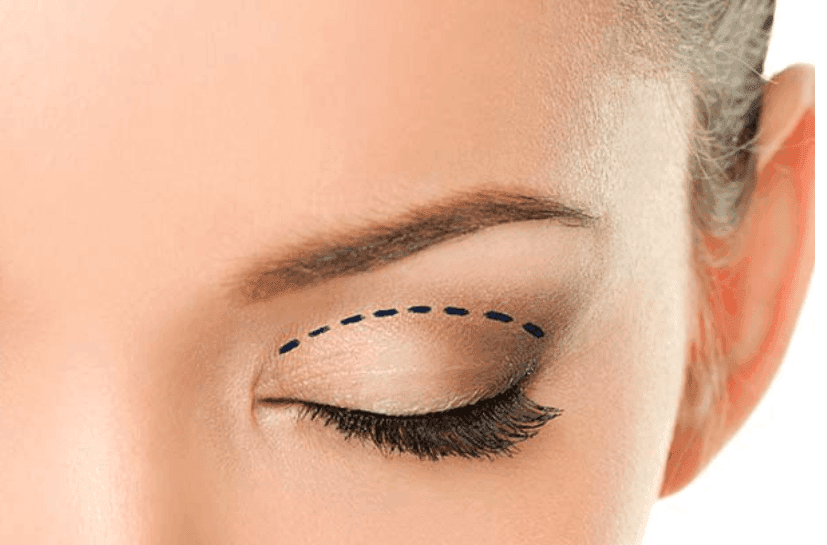
In the upper eyelid, the crease is formed by extensions of the levator aponeurosis passing through the orbicularis oculi and inserting into the skin.
The free margin of the eyelid measures about 25–30 mm. Medially, there is the punctum and lacrimal canaliculus; laterally, eyelashes and Moll’s glands are present.
1.2. Muscle
The orbicularis oculi encircles the palpebral fissure and is divided into orbital and palpebral portions. Near the lid margin, its fibers condense into the medial and lateral canthal tendons.
1.3. Tarsus and Conjunctiva
The tarsus is dense fibrous tissue providing structural support. The upper tarsus is about 10 mm high, the lower about 5 mm. Each end attaches to the canthal tendons.
The superior border of the upper tarsus is connected to Müller’s muscle and the orbital septum.
The levator aponeurosis inserts onto the anterior surface of the upper tarsus.
The inferior border of the lower tarsus is attached to the orbital septum and capsulopalpebral fascia.
Conjunctiva adheres firmly to the posterior tarsal surface, lining the entire posterior eyelid.
II. Reconstruction of Upper Eyelid Defects
Defects of the upper eyelid are less common than lower lid defects but have more serious functional and cosmetic consequences. Reconstruction follows Mustardé’s principles and the “¼ rule”.
2.1. Small Skin Defects
Small, spindle-shaped horizontal defects can often be closed directly due to the high elasticity of the upper lid skin.
Larger defects may require thin split-thickness skin grafts, or full-thickness grafts harvested from the contralateral upper eyelid. Local flaps from the ipsilateral lower lid generally match thickness better than flaps from the nasolabial fold or temple.
2.2. Full-Thickness Defect Involving ¼ of Upper Lid
Converted into a pentagon with its base at the lid margin, then reconstructed in three separate layers to avoid lid deformity. Special care is needed at the lid margin to prevent misalignment and severe lid notching.
2.3. Full-Thickness Defect of ½ of Upper Lid
Abbé flap: harvested from the lower lid, of equal size to the defect, with a 5 mm wide pedicle placed medially. Donor site is closed primarily. The flap is inset in three layers; the pedicle is divided after 3 weeks.
Composite graft: harvested from the contralateral eyelid, including skin, tarsus, and conjunctiva (orbicularis muscle may be excluded). Results are less stable compared to flaps.
2.4. Full-Thickness Defect of ¾ of Upper Lid
Abbé flap: harvested from one-quarter to one-half of the lower lid length, pedicle ~5 mm wide, rotated medially or laterally. Donor site is closed with a Mustardé temporal rotation flap.
Cutler–Beard flap: designed so flap width equals half the lower lid length, taken 5 mm below the lid margin, full-thickness. The flap is tunneled behind the lower lid margin and sutured to the upper lid defect. Pedicle is divided after 2 months. Because it lacks tarsus, additional cartilage grafting is required.
2.5. Total Upper Eyelid Defect
Abbé–Mustardé technique: rotation flap from the lower lid (up to ¾ its length), always pedicled medially. Donor site closed with a Mustardé temporal flap and nasal septal cartilage–mucosa graft. Pedicle divided after 3 weeks.
Morax technique: transfers the defect inferiorly, rotating the outer half of the lower lid upward to cover the inner half of the upper lid. After 3 weeks, the remaining lower lid is advanced to complete the reconstruction. Donor site is covered with a nasolabial flap.
III. Reconstruction of Lower Eyelid Defects
3.1. Skin Defects
Small defects: converted to a spindle shape oriented along natural wrinkles, closed directly.
Full-thickness grafts are unsuitable for large defects; thin grafts from the upper lid may cover defects near the margin. For larger areas, grafts from postauricular, cervical, or supraclavicular skin are used.
Local rotation, advancement, or transposition flaps (nasolabial, temporal, or upper lid–based) are preferred for moderate-sized defects, preserving lid contour.
3.2. Full-Thickness Defect of ¼ Lower Lid
Direct closure is possible for defects less than one-quarter lid length, reconstructed in three layers. Tarsoconjunctiva is closed with 6-0 absorbable running sutures, tied externally.
3.3. Full-Thickness Defect of ½ Lower Lid
In elderly patients, direct closure may be possible after lateral cantholysis (cutting the lower limb of the lateral canthal tendon) to relieve tension.
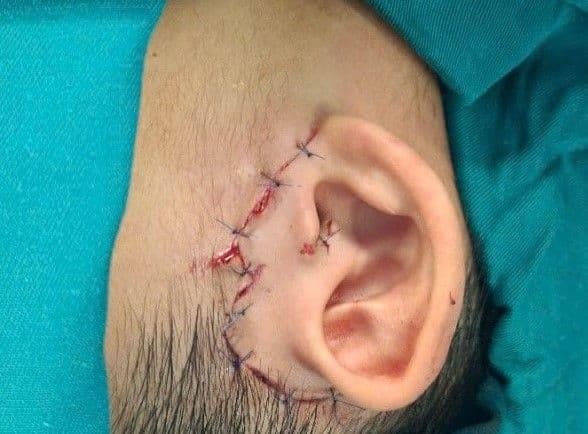
Mustardé cheek–temporal rotation flap: designed from the lateral canthus upward toward the temple and curving behind the ear. The flap is rotated to cover the defect, with conjunctival graft placed internally.
3.4. Full-Thickness Defect > ½ Lower Lid
Mustardé cheek–temporal flap with nasal septal cartilage–mucosa graft for internal lining.
Upper lid myocutaneous flap with septal cartilage–mucosa graft (Texier technique).
For medial canthus–adjacent defects, grafts are anchored to the medial canthal tendon or periosteum of the lacrimal crest.
3.5. Total Lower Eyelid Defect
These usually involve the lacrimal drainage system; reconstruction of the canaliculi is delayed 3–4 months. Options include:
Mustardé cheek–temporal rotation flap, extended to the cervicofacial region, fixed medially to the canthal tendon.
Upper lid myocutaneous flap (Texier) combined with full-thickness skin graft.
Nasolabial flap with septal cartilage–mucosa graft for inner lining.
Large temporal flaps with inferior or superior pedicles are rarely used due to unreliable venous return.
IV. Reconstruction of the Canthi
4.1. Medial Canthus
Injuries here are more common than at the lateral canthus. The priority is reconstructing the medial canthal tendon, with lacrimal system reconstruction postponed.
Medial canthus and lower lid: secure tarsus/flap edge to the medial canthal tendon or periosteum. Cover defect with a nasal root rotation flap.
Medial canthus and both lids: for small bilateral defects, suture medial lid edges to nasal periosteum and perform dacryocystorhinostomy to prevent epiphora. For larger bilateral defects, use a forehead rotation flap to cover both lids and medial canthus; the flap’s undersurface is lined with oral mucosa.
4.2. Lateral Canthus
Defects here may be reconstructed with a supra-brow rotation flap, which is suitable for covering the lateral canthal region.